
About me
I started writing Solla-Rose’s fiction at 21 years old. At that time I had been struggling with an eating disorder for 4 years already, and it was only getting worse. I was very good at hiding it.
I created her because at 21 years old I left France for one year, with a visa to be an au pair in the States. Not going into details, but I got fired after 3 months, and it was the best thing that could have happened, really. It was the 1st day of the rest of my life, as we say.
But when it happened, it hurt. Imagine going back to France with nothing after 3 months, when I was supposed to stay 1 year — my pride was at rock bottom.
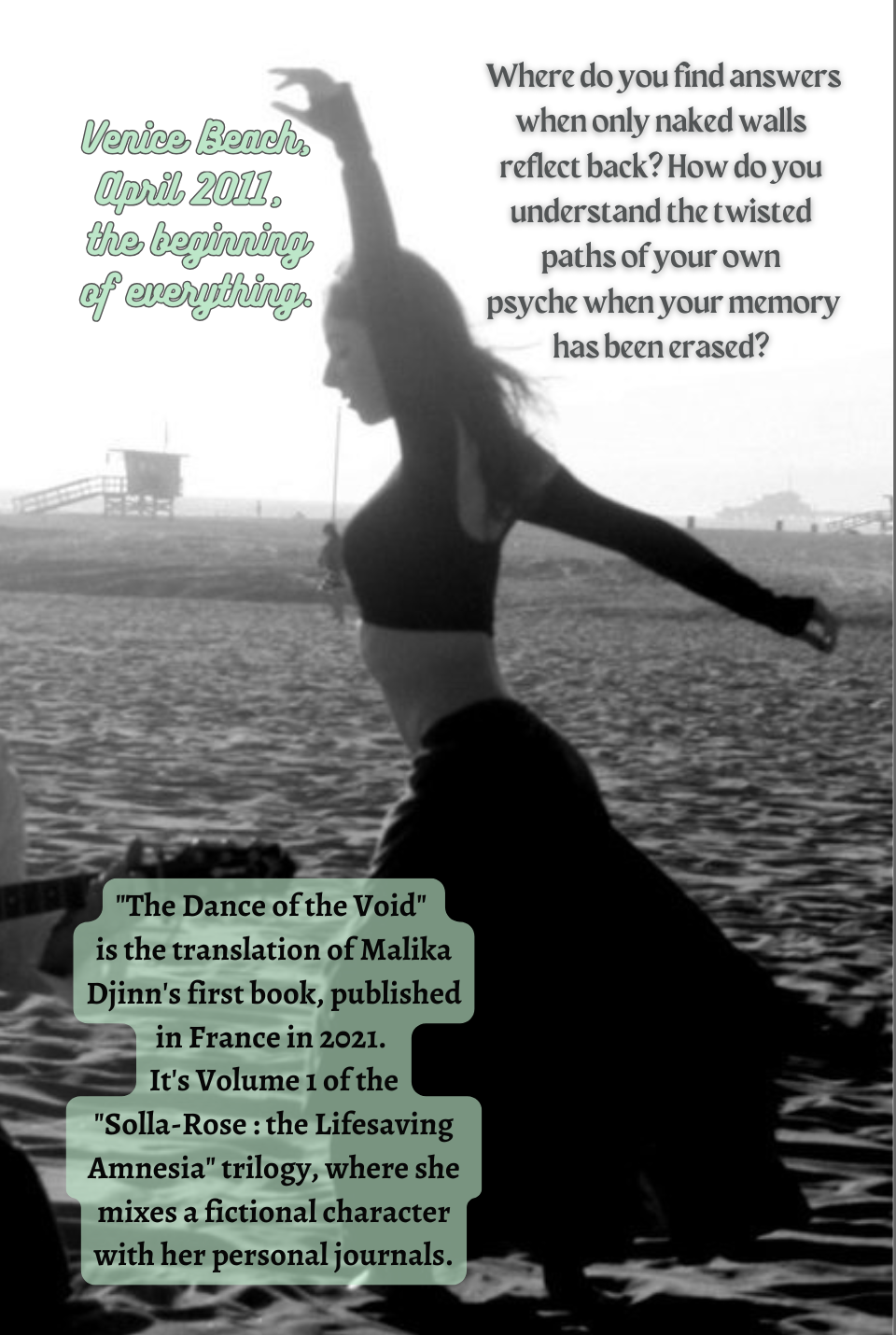
But Solla-Rose followed me. After that (un)fortunate event, I went to Venice Beach with no plans and a dream: dancing. This picture you see on the left, which is the back cover of my book, is from this little vacation that changed my life. April 2011 — the beginning of everything.
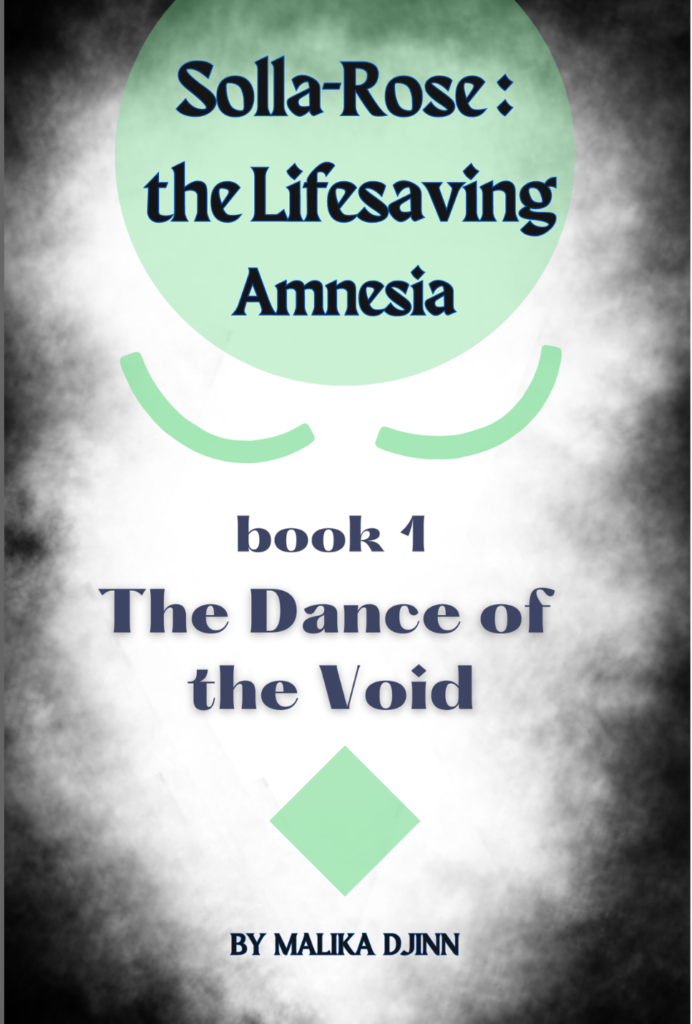
The Dance of the Void, book 1 of the “Solla-Rose: the Lifesaving Amnesia” trilogy
After a fall that breaks her body and erases her memory, Solla-Rose finds herself in the care of Lilith : a witch-caretaker who can heal flesh, but not the deeper wound of a fractured identity. What follows is an initiatory journey through the world of Merrick A., a richly imagined dystopia where jet-set excess and underground rebellion collide.
Nothing in this universe is left to chance. Through Solla-Rose’s search for herself ; open to every experience, however extreme or ambiguous ; the novel deciphers the most unsettling preoccupations of a generation, without pity and without pretense.
Woven throughout the narrative, the pages of an intimate travel diary surface repeatedly within each chapter : the author’s own words, written in the grip of bulimia. Though the worlds are different and the timelines don’t align, the echoes are impossible to miss: Solla-Rose’s wanderings were born from Malika’s own travels, and the reader will find themselves moving between fiction and lived reality, noticing the bridges that quietly connect them. Two voices, two journeys, one searing the other into existence.
Originally published in France in 2021, The Dance of the Void is Malika Djinn’s debut novel and the first volume of the Solla-Rose trilogy : a quest for self in all the tragedy of modern times.
As Malika Djinn writes in her prologue: “Enjoy discovering the neuroses of a modern society product.”
You can buy the volume 1 of my trilogy on Amazon
The avatar as a
therapeutic tool :
"Conjuring your avatar"
workshop
I grew up in a home where books on spirituality and personal development filled every bookshelf, and I heard about Carl Jung’s work at quite a young age. The archetypes, the collective unconscious, the shadows… But I had never truly dived into his work — I only had a surface-level knowledge of his theories.
Until the day I began emerging from a traumatic amnesia rooted in my childhood. Several amnesias, to be precise, since they involved multiple moments. It is deeply disorienting to have to revisit the entire story you had built of yourself and your childhood, and to realize that a large piece of the puzzle had been missing. Carl Jung’s work on the unconscious helped me greatly during that period, because I needed to understand: why and how had I forgotten these traumas? That part of my story.
Very quickly, his studies on what he calls “active imagination” captivated me. Because the truly remarkable point in all of this is that when I created the story of Solla-Rose in 2010 — whose central theme is her amnesia — I had no awareness whatsoever that I, too, was amnesiac. A remarkable coincidence, to say the least.
My writing workshops centered on the avatar are therefore shaped by my own experience, by Jung’s theories, and by neuroscience. The core idea is that when we are in a creative state, our brain frequencies slow down. From alpha and beta, they shift to theta. Theta frequencies are emitted by our brain as we are falling asleep or waking up. These waves are the gateway between the unconscious and consciousness. Remembering our dreams, for example, is unconscious material connecting with our consciousness — since we are able to recall it. The dreams that pass through us when our brain vibrates at delta, for instance, we do not remember; they remain in the unconscious.
So, when we create — whether it is painting, dance, or writing — our brain slows down and that gateway between the conscious and the unconscious opens. The ideas that come to us while we create are nourished by elements of our story that we are not aware of. The famous “shadows” of shadow work.
My goal through these workshops — which can also take the form of 1:1 sessions — is to help people navigate the parts of themselves they are not conscious of, but which are seeking to be heard.
When we write a story, nothing is impossible. Nothing is unimaginable. That is precisely why certain aspects of our being, which normally remain well hidden in the unconscious, can surface during creative writing work — because we are not analyzing ourselves; we are inventing the story of a character who resembles us, but who is not us. And that is where all the magic happens.
The idea of closing the workshop with 15 minutes of intuitive dance came to me after attending several masterclasses with the Tamalpa Institute, and then reading the book by Daria Halprin, whose mother Anna Halprin founded the institute and the art therapy method “………” . According to this method — itself inspired by Jungian theories — using different artistic media allows different levels of stagnant emotions to be unlocked, thereby healing even more conscious or unconscious wounds.